


Do Farm Trucks Need an ELD? The Ag Exemption Explained
September 1, 2026 - 8:47:03 am
Quick Summary: Whether farm trucks need an ELD depends on which of two separate federal exemptions applies. The agricultural commodity exemption waives Hours of Service and ELD rules within a 150 air-mile radius of where the crop or livestock originated, while the covered farm vehicle exemption covers a farmer's own truck more broadly but only for private, non-for-hire use. Most ND and MN farm trucks qualify for one or both — but the details matter.
Do Farm Trucks Need an ELD? Short Answer: It Depends on Which Exemption Applies
For most farm and ranch operations hauling their own grain, livestock, or supplies, the honest answer to "do farm trucks need an ELD" is no — but only because two separate federal exemptions typically cover that work, not because farm trucks are exempt from trucking regulation altogether. The Federal Motor Carrier Safety Administration (FMCSA) built these exemptions specifically because agricultural hauling doesn't fit the same predictable, long-haul pattern that Hours of Service (HOS) and Electronic Logging Device (ELD) rules were designed around. Knowing which exemption applies — and where it stops applying — is what keeps a harvest-season hauler legal instead of accidentally out of compliance the moment a load crosses an invisible line on the map.
The Two Federal Farm Truck Exemptions, Compared
| Feature | Agricultural Commodity Exemption | Covered Farm Vehicle Exemption |
|---|---|---|
| What's exempted | HOS and ELD requirements | CDL, drug/alcohol testing, medical certification, HOS, and vehicle inspection rules |
| Who can use it | Any driver hauling agricultural commodities, livestock, bees, or farm supplies — for-hire or private | Only the farm/ranch owner, operator, or their family member or employee — not for-hire operations |
| Distance/weight limit | Within a 150 air-mile radius of the source of the commodity | 26,001 lbs GVWR/GCWR or less: exempt anywhere in the U.S. Over 26,001 lbs: exempt only within the state of registration or within 150 air miles across state lines |
| Vehicle requirement | None specific to the vehicle itself | Must carry a state-issued license plate or designation identifying it as a farm vehicle, per 49 CFR 390.5 |
| Seasonal limit | Applies during planting and harvesting periods as determined by the state | No seasonal restriction |
| Hazmat loads | Not covered for placarded hazardous materials | Explicitly excluded for any load requiring a hazmat placard |
How to Determine Which Exemption Applies to Your Farm Truck
Step 1: Identify Who's Driving and What's Being Hauled
If the truck is owned or operated by the farm itself — driven by the owner, a family member, or a farm employee, and hauling the farm's own crops, livestock, machinery, or supplies rather than for-hire freight — start by checking the covered farm vehicle rules. If a third-party or for-hire carrier is doing the hauling, the agricultural commodity exemption is the one that can apply instead.
Step 2: Measure the Distance from the Source
For the agricultural commodity exemption, measure from the actual source of the commodity — the field, the ranch, the grain bin — not the final destination. Staying within 150 air miles of that source keeps both HOS and ELD requirements off the table entirely, for both loaded and empty legs. Cross that radius, and standard HOS and ELD rules apply immediately, with no grace period.
Step 3: Check the Truck's Weight Rating
For the covered farm vehicle exemption, 49 CFR 390.5 draws a hard line at 26,001 lbs GVWR/GCWR. At or under that weight, the exemption travels with the truck anywhere in the country. Above it, the exemption only holds inside the state of registration, or within 150 air miles across a state line — which is exactly the kind of detail that matters for ND and MN operations running heavier T880- or T480-class straight trucks near a state border.
North Dakota's Farm CDL Reciprocity: What ND and MN Operators Need to Know
North Dakota has a specific advantage worth knowing about here: the North Dakota Highway Patrol confirms that North Dakota has reciprocity agreements for farm CDL exemptions with South Dakota, Minnesota, Montana, and Wyoming, when operating within 150 air miles of the farm. For an ND grain or livestock operation that regularly crosses into Minnesota, South Dakota, or Montana during harvest, that reciprocity means the farm CDL exemption doesn't quietly disappear the moment a truck crosses the state line — as long as the trip stays inside that 150-air-mile window.
Frequently Asked Questions
Do I need an ELD to haul grain to the elevator?
Not if the elevator is within 150 air miles of the field or bin where the grain originated — that trip falls under the agricultural commodity exemption, which waives both HOS and ELD requirements for the entire trip, loaded or empty.
What happens if I go past the 150 air-mile radius?
Standard HOS and ELD rules apply the moment you exceed the radius, with no grace period. Drivers who occasionally exceed it need to log that portion of the trip under normal HOS rules.
Does the covered farm vehicle exemption cover hired drivers?
Yes, as long as the driver is an employee of the farm or ranch operating the farm's own vehicle for the farm's own agricultural hauling — it does not extend to for-hire trucking companies contracted to haul for a farm.
Do these exemptions apply to hazmat loads like fertilizer or fuel?
No. Both exemptions specifically exclude loads that require a hazmat placard, regardless of who's driving or how far the trip goes.
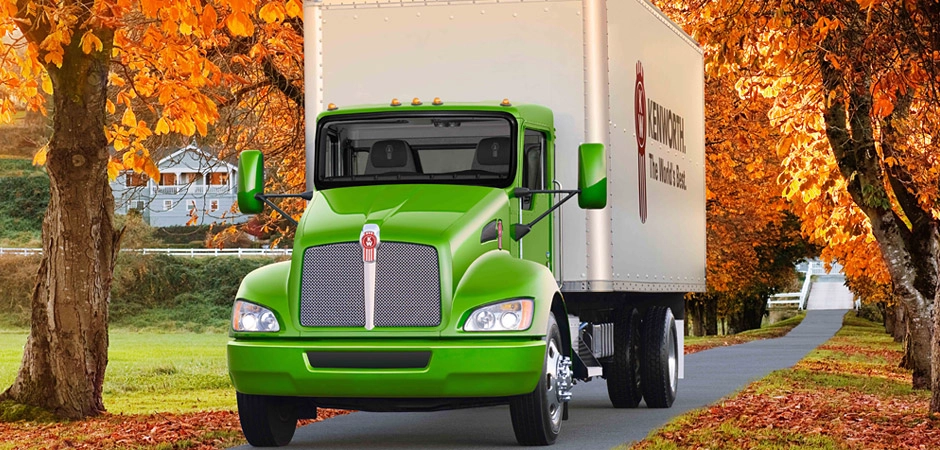
Spec the Right Farm Truck at Wallwork Truck Center
Whether your operation runs under the covered farm vehicle exemption, the agricultural commodity exemption, or both, the truck itself still needs to be built for real ag work — grain, livestock, and equipment hauling across North Dakota and western Minnesota's toughest seasons. Wallwork Truck Center's Kenworth T880 and T480 lineups are built for exactly this kind of vocational ag duty. Browse our full truck and trailer inventory or contact our sales team to spec a truck for your operation before the next planting or harvest season starts.