


Spec'ing a Truck for Aggregate and Gravel Hauling
September 3, 2026 - 8:47:03 am
Quick Summary: Spec'ing a truck for aggregate hauling comes down to three decisions: axle configuration (which sets your legal payload), dump body steel grade (AR400 vs. AR450), and hoist type (underbody vs. telescopic). Get those three right for your actual routes and load cycle, and the rest of the spec sheet follows.
Spec'ing a Truck for Aggregate and Gravel Hauling Starts With Axle Configuration
Before steel gauge or hoist type, axle configuration is the decision that sets your legal payload ceiling — and payload is what determines how many loads it takes to move a given pile of gravel from pit to job site. More axles spread the load over more contact points, which raises the truck's legal gross vehicle weight rating (GVWR) under federal and state bridge formulas.
| Axle Configuration | Typical Payload | Typical GVWR |
|---|---|---|
| Single-axle | 6–10 tons | 26,000–33,000 lbs |
| Tandem-axle | 12–16 tons | 54,000–65,000 lbs |
| Tri-axle | 18–25 tons | 65,000–80,000 lbs |
| Quad-axle / Super Dump | 20–26 tons | 80,000+ lbs |
For short, repetitive quarry-to-site aggregate runs — the bread-and-butter cycle for most ND and MN gravel haulers — the added payload of a tri-axle or quad-axle configuration usually pays for itself quickly by cutting the number of round trips needed to move the same tonnage.
Dump Body Steel: Why AR400 and AR450 Matter for Aggregate Work
Aggregate is abrasive by nature — crushed rock and gravel wear through a standard mild-steel dump body far faster than it wears through a body built with abrasion-resistant steel. AR400 steel (the "AR" stands for abrasion resistant, the "400" for its roughly 360–440 Brinell hardness rating) is the baseline choice purpose-built for dump beds handling exactly this kind of material. AR450 steps up to a 430–480 Brinell rating, offering meaningfully better wear resistance at the cost of being somewhat harder to form and weld during fabrication.
For straight aggregate and gravel hauling, high-strength steel dump bodies are the industry standard specifically because of their resistance to wear and impact — a body that flexes or thins out under years of loose rock loading directly costs money in early replacement.
Choosing the Right Hoist: Underbody vs. Telescopic Cylinders
The hoist is what actually lifts the dump body, and the two dominant designs solve different problems. An underbody hoist mounts low and offers a lower center of gravity and improved stability during the dump cycle — a real advantage on uneven quarry or job-site ground. A telescopic cylinder, mounted at the front of the body, delivers a steeper dump angle and greater lift capacity, which matters most when material doesn't want to slide out cleanly on its own.
For straight aggregate hauling, dry gravel and crushed rock generally clear an underbody hoist's dump angle without issue, which is why many aggregate-focused fleets default to it for the stability advantage. Operators regularly hauling stickier or wetter material alongside aggregate — wet sand, asphalt millings — lean toward telescopic cylinders for the steeper dump angle that clears material more reliably.
How to Spec Your Aggregate Hauler
Step 1: Calculate Your Actual Payload Need
Start from the real numbers: typical haul distance, cycle time, and how many tons per day the job requires — not just "the biggest truck available." A tandem-axle truck making short, frequent runs can out-earn an underutilized tri-axle sitting half-loaded.
Step 2: Match Axle Configuration to That Payload
Use the payload table above as a starting point, then confirm the exact GVWR with your dealer against the specific chassis and suspension you're spec'ing — advertised ranges vary by manufacturer and build.
Step 3: Confirm Dump Body Steel and Hoist Against Your Material and Ground Conditions
Choose AR400 as the default for standard aggregate work, step up to AR450 if the material is especially abrasive or the body needs to last through heavier duty cycles, and pick underbody vs. telescopic hoist based on how reliably your specific material clears the body under gravity alone.
Staying Legal in North Dakota: Axle Weight Limits for Gravel Haulers
North Dakota's own weight limitations, published by the North Dakota Highway Patrol, cap a single axle at 20,000 lbs and a tandem axle at 34,000 lbs, with total gross weight governed from there by axle spacing and configuration. This is exactly why axle configuration matters so much for a gravel hauler running the same pit-to-site route dozens of times a day: a tri-axle or quad-axle setup spreads weight across more axles, which is what allows a legally heavier total load per trip within North Dakota's axle limits — directly reducing the number of trips needed to move a given tonnage.
Frequently Asked Questions
How many tons can a tri-axle dump truck haul?
A tri-axle dump truck typically carries 18 to 25 tons of payload, depending on the specific chassis, body weight, and GVWR rating — always confirm the exact figure for your build rather than assuming the high end of the range.
Is AR450 always better than AR400 for a dump body?
Not necessarily. AR450 offers better wear resistance, but AR400 is easier to form and weld and holds up fine for standard aggregate duty cycles — AR450 earns its cost premium mainly on especially abrasive material or heavier-than-average duty cycles.
Do I need a telescopic hoist for aggregate hauling?
Not usually. Dry gravel and crushed rock generally dump cleanly with an underbody hoist, which also offers better stability. Telescopic hoists earn their place when the load includes stickier or wetter material that needs a steeper dump angle to clear.
What chassis does Wallwork recommend for gravel hauling?
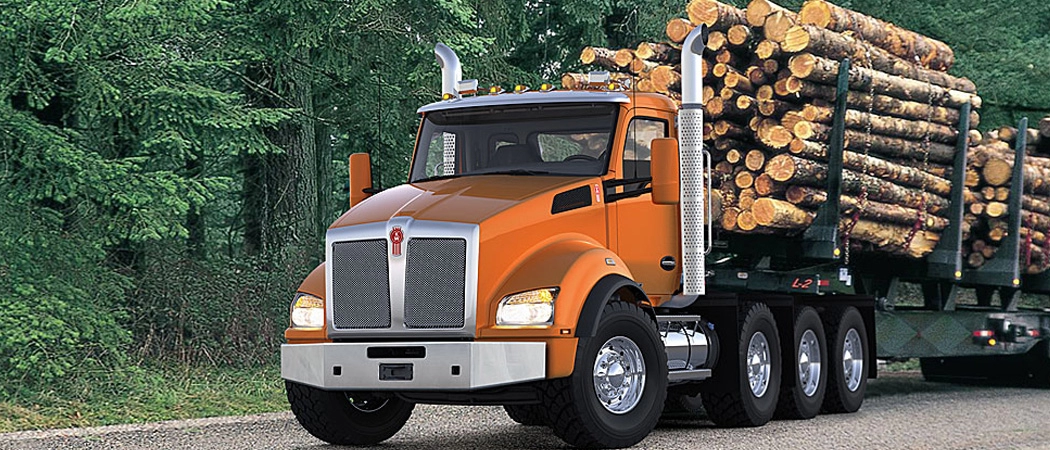
The Kenworth T880 is Wallwork's core vocational chassis for dump and aggregate work, thanks to its sloped hood visibility and vocational-duty frame options — talk to our sales team about matching it to your specific axle and body spec.
Build Your Aggregate Hauler at Wallwork Truck Center
Getting the axle configuration, dump body steel, and hoist type right up front is what keeps an aggregate hauling truck profitable for years instead of needing an early rebuild. Wallwork Truck Center specs Kenworth T880 chassis for exactly this kind of vocational duty, and carries Demco dump and side-dump trailers built for North Dakota and western Minnesota construction and aggregate work. Browse our full inventory or contact our sales team to spec your next gravel hauler.