


R-WAY Trailers: Features and Best Use Cases
October 8, 2026 - 10:22:41 am
Quick Summary: R-WAY trailers cover four main jobs: bottom dump, side dump, tank, and specialty hauling, each built around a specific unloading method rather than a one-size-fits-all design. A bottom dump trailer windrows aggregate fast on a stable chassis, a side dump trailer unloads to either side without leveling the ground first, and tank trailers move liquids and sand in steel built for the load. Picking the right one comes down to what material you're hauling and what the job site looks like.
What Is the R-WAY Trailer Line?
R-WAY has built dump and tank trailers for construction, aggregate, and bulk-material hauling for decades, and the line is produced today under Krain Creek Fabrication. Wallwork Truck Center sells R-WAY trailers alongside its other trailer lines (Great Dane, XL Specialized, Demco, Prestige, Stephens, Vanguard, and East), and the R-WAY lineup is specifically built around dump and tank work rather than dry van or flatbed freight.
The lineup splits into four families: Bottom/Belly Dump Trailers, Side Dump Trailers, Tank Trailers, and a handful of Specialty Trailers built for a narrower job. Each one exists because the three main dump styles — end, side, and bottom — solve different problems, and R-WAY's catalog skips end dump trailers entirely in favor of the other two.
Bottom Dump vs. Side Dump: Which R-WAY Trailer Fits Your Hauling Job?
Before choosing between a bottom dump trailer and a side dump trailer, it helps to know what each design is actually good at. The table below breaks down how the three major dump-trailer styles compare on stability, capacity, and material handling.
| Dump Style | Best For | Key Advantage | Key Limitation |
|---|---|---|---|
| End Dump | Debris, demolition material, large loads | Largest practical payload per trailer | Stability risk on uneven ground; not for liquids (rear gate leaks) |
| Side Dump | Road building, excavation, pit work, soft or uneven sites | Most stable unloading method; no leveling or air-suspension deflation needed | Smaller cubic capacity than end dump; needs more room to swing the body |
| Bottom Dump | Asphalt paving, aggregate stockpiling, windrowing | No rollover risk; built to maximize payload-to-weight ratio; fast turnaround | Needs ground clearance above the windrow; not for liquids or fine leaking material |
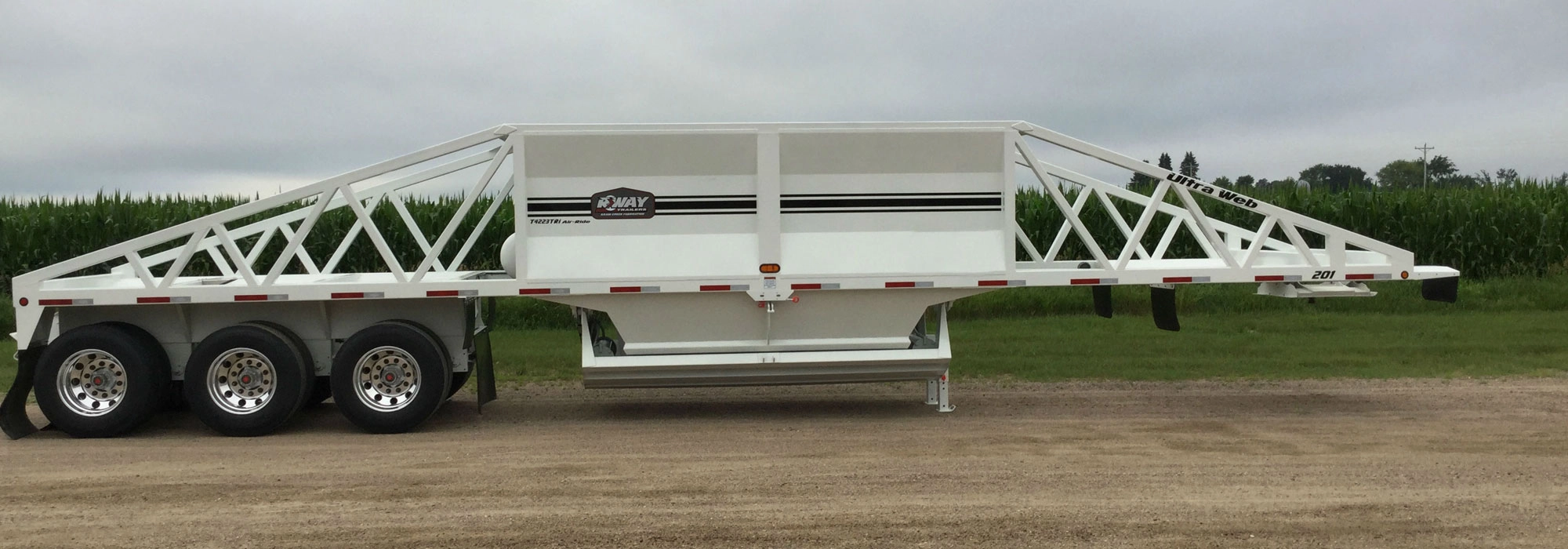
R-WAY's Bottom/Belly Dump Trailers come in three versions — Premium, Heavy Duty, and Lite Weight — so a contractor can match the trailer's tare weight and construction to the job instead of overbuying capacity they don't need. The Lite Weight version trims structural weight to maximize legal payload on standard aggregate runs, while the Heavy Duty version is built for contractors hauling denser or more abrasive material on a regular basis.
Side Dump Trailers: Stability Without Leveling the Load
R-WAY's Side Dump Trailers, built under the Centerline R-WAY Ultra Line, are available in tandem and tri-axle configurations with up to 24.6 cubic yards of capacity. The tub is built from ¼-inch AR400F steel, with Hardox steel available as an upgrade for contractors hauling sharper or more abrasive aggregate.
What sets a side dump apart mechanically is the counterbalancing hydraulic valve system: two 5-inch hydraulic cylinders rated to 3,000 psi raise the tub while the valve keeps the load balanced, so the trailer can unload from either the driver side or curb side without tipping or needing the site to be perfectly level first. That's the main reason crews pick a side dump over a bottom dump on pit sites, excavation work, or soft ground where leveling every unloading spot isn't practical. The trailers ride on SAF Holland air ride suspension with anti-lock brakes standard, and the body unloads in both directions without repositioning the truck.
Tank and Specialty Trailers for Everything Else
Not every hauling job is dry aggregate. R-WAY's Tank Trailers are built in either A36 steel or A588 high-strength, corrosion-resistant steel, depending on whether the load is water, liquid asphalt, sand, or another material that would eat through standard steel over time.
The Specialty Trailers cover jobs that don't fit the standard dump or tank categories: a 40 cubic yard all-steel Ash Trailer built for hauling fly ash, and a 53-foot Drain Tile Trailer with tongue-and-groove decking for moving drain tile sections without the load shifting in transit.
R-WAY Trailers for ND and MN Construction and Aggregate Work
North Dakota and western Minnesota contractors run dump and tank trailers through a wider range of conditions than most of the country — gravel township roads, winter freeze-thaw cycles that chew up pavement, and aggregate pits that aren't always graded flat. A side dump's ability to unload on uneven ground without leveling matters more here than it would on a paved commercial site, and a bottom dump's windrowing capability lines up directly with the asphalt and road-base work that keeps rural ND roads passable through the year.
Wallwork's locations in Fargo, Grand Forks, Bismarck, Dickinson, Williston, Fergus Falls, and Minot mean parts and service for a R-WAY trailer are available close to most job sites in the region, not just at a single central shop.
Frequently Asked Questions
What's the difference between a bottom dump trailer and a side dump trailer?
A bottom dump trailer releases material through doors in the floor, usually while moving, to lay down a controlled windrow — common for asphalt and road-base work. A side dump trailer tips the entire tub to one side to dump a full load at once, which works better on soft or uneven ground where windrowing isn't practical.
Can a R-WAY side dump trailer unload on uneven ground?
Yes. The counterbalancing hydraulic valve system is designed specifically to keep the trailer stable while dumping, so it doesn't need the unloading area leveled first the way some other trailer types do.
Why does R-WAY offer three versions of its bottom dump trailer?
The Premium, Heavy Duty, and Lite Weight versions let a contractor match the trailer's weight and build quality to the job — Lite Weight maximizes legal payload for standard aggregate hauling, while Heavy Duty is built for denser or more abrasive material hauled on a regular basis.
What steel do R-WAY tank trailers use?
R-WAY builds tank trailers in either A36 steel or A588 high-strength, corrosion-resistant steel, depending on what's being hauled and how corrosive the material is over time.
Find the Right R-WAY Trailer at Wallwork Truck Center
Picking between a bottom dump, side dump, or tank trailer comes down to the material, the job site, and how much payload you need to move in a day. Wallwork Truck Center carries R-WAY trailers alongside Great Dane, XL Specialized, Demco, Prestige, Stephens, and East, so it's worth comparing more than one line before deciding. Browse current trailer inventory, see what's available in new trailers or used trailers, check financing options, or contact your nearest Wallwork location to talk through which R-WAY configuration fits your hauling job.