


PACCAR MX-11 vs. MX-13: Which Engine is Best for Weight-Sensitive Hauling?
April 23, 2026 - 8:21:43 am
When you are spec'ing a new Kenworth truck for bulk hauling, regional distribution, or vocational applications, every single pound matters. In the world of weight-sensitive hauling, maximizing your payload directly correlates with maximizing your profitability. A lighter truck means you can legally carry more product, but you still need a powertrain capable of moving that product efficiently.
This brings us to one of the most critical decisions fleet managers and owner-operators face at Wallwork Truck Center: choosing between the PACCAR MX-11 and the PACCAR MX-13 engines. Both are marvels of modern engineering, delivering exceptional fuel economy and reliability, but they serve distinctly different operational needs. In this comprehensive guide, we will break down the PACCAR MX-11 vs. MX-13 debate, focusing heavily on dry weight comparisons, bulk hauling dynamics, and horsepower-to-weight ratios to help you make the best decision for your business.
The Core Powertrain Comparison: PACCAR MX-11 vs. MX-13
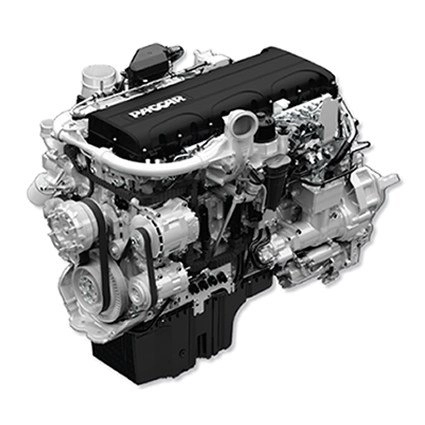
To understand which engine suits your Kenworth best, we first need to look at the baseline architecture of these two PACCAR powerplants. Both engines are built with compacted graphite iron (CGI) blocks and heads, which offer superior strength and weight reduction compared to traditional gray cast iron. However, their displacement and design targets differ significantly.
- PACCAR MX-11: This 10.8-liter engine is designed specifically for weight-sensitive and vocational applications. It delivers up to 430 horsepower and 1,650 lb-ft of torque. The MX-11 is engineered to punch above its weight class, offering 13-liter performance in an 11-liter package.
- PACCAR MX-13: This 12.9-liter engine is the heavy-duty workhorse of the PACCAR lineup. It scales up to 510 horsepower and 1,850 lb-ft of torque. It is designed for maximum durability and pulling power, particularly for over-the-road hauling and maximum Gross Combination Weight (GCW) applications.
While the MX-13 offers the ultimate in raw power, the MX-11 introduces a strategic advantage for specific applications where tare weight is the primary concern.
The 400-Pound Advantage: Dry Weight Comparisons
The most vital statistic in the PACCAR MX-11 vs. MX-13 comparison for bulk haulers is the dry weight. The PACCAR MX-11 provides an impressive 400-pound weight advantage over the MX-13. In bulk hauling operations—such as transporting aggregates, agricultural products, or liquids—revenue is calculated by the ton or the gallon. If your Kenworth truck weighs 400 pounds less when empty (the tare weight), you can legally add 400 pounds of paying freight to every single load.
Let's do the math on how this dry weight advantage translates to your bottom line:
- If your truck completes 5 loads a day, that is an extra 2,000 pounds of payload per day.
- Over a standard 5-day work week, you are moving an extra 10,000 pounds.
- Over a year, this 400-pound engine weight difference equates to hundreds of thousands of pounds of extra billed freight, all without exceeding legal weight limits.
For weight-sensitive haulers, the MX-11 isn't just an engine choice; it is a revenue-generating asset driven entirely by its lower dry weight.
Horsepower-to-Weight Ratios Explained
When comparing the PACCAR MX-11 vs. MX-13, you cannot look at weight or horsepower in a vacuum; you must evaluate the horsepower-to-weight ratio.
The MX-13 provides undeniable lugging power for mountain grades and maximum legal gross weights. However, that extra power comes with a physical mass penalty. If your Kenworth is hauling 80,000 pounds on relatively flat terrain, the 430 horsepower of the MX-11 is more than sufficient. Because the MX-11 is 400 pounds lighter, its horsepower-to-weight ratio is highly optimized for regional and bulk applications. The engine does not have to work as hard to move its own mass, which often translates to subtle improvements in fuel efficiency and less wear on front-axle components.
Conversely, if you are regularly running at maximum gross weights through steep mountainous terrain, the MX-13's higher torque output will maintain higher average road speeds, reducing trip times. In this scenario, the extra 400 pounds of engine weight is justified by the operational efficiency gained from the higher power output.
Pros and Cons: Payload vs. Power Trade-Offs
Here is a strict breakdown of the payload versus power trade-offs.
PACCAR MX-11
- PRO: 400 lbs lighter dry weight allows for a direct 400 lb increase in billable payload capacity per trip.
- PRO: Optimized horsepower-to-weight ratio for flat or rolling terrain, maximizing fuel economy while maintaining legal speeds.
- PRO: Reduces front axle weight, offering more flexibility in fifth-wheel placement and load distribution for bulk trailers.
- CON: Lower peak horsepower (up to 430 hp) means slower climbing speeds on steep, extended mountain grades when fully loaded.
- CON: Lower torque ceiling (1,650 lb-ft) may require more frequent downshifting in challenging topography compared to a 13-liter engine.
PACCAR MX-13
- PRO: Higher peak power (up to 510 hp) and torque (1,850 lb-ft) provide effortless pulling power, reducing driver fatigue in mountainous regions.
- PRO: Maintains higher average road speeds on inclines, improving overall route times for maximum-weight over-the-road applications.
- CON: The 400 lb heavier dry weight directly subtracts 400 lbs from your maximum legal payload capacity on every single load.
- CON: The added mass on the steer axle can restrict load distribution flexibility, particularly in strict bridge-law states or sensitive bulk applications.
Making the Right Choice for Your Kenworth Truck
The conclusion of the PACCAR MX-11 vs. MX-13 debate ultimately rests on your specific routes and freight. If you are hauling bulk commodities where you max out on weight before you max out on trailer space, the 400-pound weight savings of the MX-11 makes it the undisputed champion. It allows you to haul more product and generate more revenue on every trip. However, if your routes are dominated by steep grades or you run heavy over-the-road freight where pulling power dictates your schedule, the MX-13 remains the gold standard.
At Wallwork Truck Center, our commercial truck experts understand the intricate balance between tare weight, horsepower, and profitability. Contact Wallwork Truck Center today, and let our team help you spec the perfect Kenworth with the ideal PACCAR powertrain for your operational needs.