


Upfitting a Ford Chassis Cab as a Grain Truck: A North Dakota Farmer's Practical Guide
August 4, 2026 - 9:35:18 am
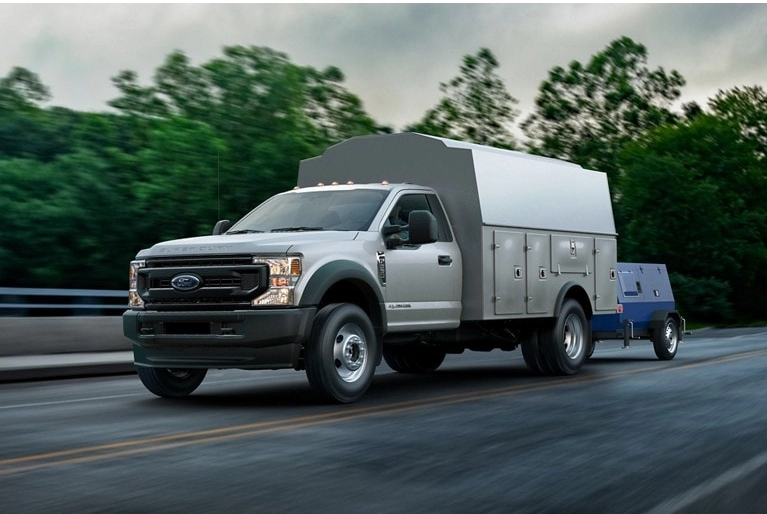
Quick Summary: A Ford chassis cab grain truck upfit — most commonly on the F-550 or F-600 — pairs a factory-ready Class 5 or Class 6 chassis with a purpose-built grain body for on-farm and bin-to-elevator hauling. Configured right, it delivers 150 to 200 bushels of legal payload per trip, stays under the 26,001 lb non-CDL GVWR threshold, and doubles as a year-round farm truck.
For a lot of North Dakota operations, a full tandem-axle semi with a hopper trailer is more truck than the job calls for — and a half-ton pickup with a small dump insert is nowhere near enough. The middle ground is a Ford chassis cab upfitted with a grain body: a purpose-built truck that hauls grain from the field to the bin, from the bin to the elevator, and pulls double duty the rest of the year. Here's the honest math and the real spec conversation, aimed at ND farmers actually shopping this platform.
Why Upfit a Ford Chassis Cab as a Grain Truck?
Three practical reasons drive most of these builds:
- Non-CDL operation. In North Dakota, a Class B CDL is required for any single vehicle with a GVWR of 26,001 lbs or more. The F-450 (up to 16,500 lb GVWR), F-550 (19,500 lb), and F-600 (22,000 lb) all stay under that line, letting family members, seasonal help, or non-CDL drivers run the truck without a commercial license. That alone changes the calculus during a labor-tight harvest.
- Cost against a bigger truck. A properly spec'd F-550 chassis cab with a mid-size grain body typically lands well under what a used tandem-axle Class 8 grain truck costs, once you factor in inspection, tires, and pre-buy repairs.
- Year-round versatility. The same chassis and hoist that dump a load of wheat in September will spread bedding in January, haul feed in March, and dump a load of gravel for the driveway in May. On a diversified ND operation, a single-purpose truck is a liability; a chassis cab grain truck upfit is a real farm truck.
Wallwork Truck Center has covered the general chassis cab platform in Ford F-550 XL: The Ultimate Fleet Foundation — this piece is the grain-specific follow-up.
F-450, F-550, or F-600? Matching the Chassis to Your Grain Operation
Ford's Class 3–6 lineup gives you three natural break points for a farm grain truck:
| Model | Max GVWR | Typical Grain Body Length | Est. Legal Payload | Best For |
|---|---|---|---|---|
| F-450 Chassis Cab | 16,500 lb | 9–10 ft | ~5,500–6,500 lb | Small operations, feed/seed, short field runs |
| F-550 Chassis Cab | 19,500 lb | 10–12 ft | ~7,000–9,500 lb | The default farm grain truck for most ND buyers |
| F-600 Chassis Cab | 22,000 lb | 12–14 ft | ~9,500–12,000 lb | Larger loads, still non-CDL, more work capacity |
Payload figures above assume a diesel drivetrain and a typical steel grain body — aluminum body construction can shift each row 1,500–2,500 lb toward more legal cargo. Note that F-600 is offered in regular cab only, per Ford — if you need a crew cab for two-person harvest crews, F-550 is the ceiling.
The Bushel Math: What Your Chassis Cab Grain Truck Can Actually Haul
Grain moves by weight, not volume, so a 12-foot grain body that could physically hold 250+ bushels of corn will run out of legal payload well before it runs out of cubic feet. On an F-550 with roughly 9,000 lb of net payload after the truck and body are weighed empty:
| Crop | Standard Test Weight (lb/bu) | Legal Bushels on F-550 (~9,000 lb payload) |
|---|---|---|
| Corn (shelled) | 56 | ~160 bu |
| Soybeans | 60 | ~150 bu |
| Wheat (spring, durum) | 60 | ~150 bu |
| Barley | 48 | ~187 bu |
| Oats | 32 | ~281 bu |
| Sunflower (oil type) | 24–32 | ~281–375 bu |
Bump up to an F-600 and every row moves 20–30% higher. Bump down to an F-450 and it drops proportionally. For ND farmers running spring wheat and durum through most of harvest, expect roughly 150–200 legal bushels per load on a well-spec'd F-550 or F-600 — enough for grain-cart-to-bin work, bin-to-local-elevator runs, or feeding a semi at the field edge, but not a replacement for a hopper trailer on long hauls.
Grain Body Options: Length, Material, and Hoist Type
Three decisions define the body:
- Length and cab-to-axle (CA) match. Ford offers cab-to-axle lengths of 60, 84, 108, and 120 inches on the chassis cab. A 60" CA suits a short 9-foot body; a 120" CA fits a 12- to 14-foot grain body cleanly. Get this wrong and the body either overhangs badly or wastes chassis behind the box. Optional aft-axle frame extensions — 42" on the 145" wheelbase and 32" on the 169" wheelbase — buy you additional length without changing wheelbase.
- Steel monobody vs. aluminum. A steel grain body is heavier (typically 2,500–3,500 lb for a 12-foot box) but shrugs off grain-cart bumps, elevator dock contact, and a decade of ND winters. Aluminum trims 1,000–1,500 lb of tare weight — cash straight back into legal payload — at a higher upfront cost.
- Scissor hoist vs. telescopic hoist. A scissor hoist lifts more evenly from the center of the box and handles slightly uneven loads better; it's the default for grain work. A telescopic (single-post front-mount) hoist can lift more weight and is preferred on gravel and mixed-duty trucks. Both are typically underbody-mounted with a 20+ gallon hydraulic reservoir.
Common accessories worth speccing in: electric roll tarp, three-piece hydraulic rear gate with a center chute, rear flood lamps, and wireless remote hoist controls.
Ford Factory Options That Matter for a Grain Truck Upfit
The chassis cab is deliberately sold as a blank canvas, but a few factory options make or break a grain-truck build:
- Live-drive PTO provision. The TorqShift 10-speed automatic transmission ships with a factory PTO provision that powers the hydraulic pump for your hoist without pulling from the tandem drive. Non-negotiable on a grain truck.
- Ford Pro Upfit Integration System (Vehicle Integration System 2.0). A single hardware interface into the truck's electrical system that lets your upfitter tie hoist controls, tarp motors, and lighting into the SYNC screen — cleaner than the old auxiliary switch approach, and less to troubleshoot down the road.
- Engine choice. The 6.7L Power Stroke V8 Turbo Diesel is the workhorse pick — high torque for hills and full loads. The 7.3L gas V8 is the lower-upfront-cost alternative with simpler cold-weather maintenance, and it's a real option for operations that don't rack up highway miles.
- Front axle capacity. Ford's best-in-class 7,500 lb FGAWR (Front Gross Axle Weight Rating) matters more than it sounds — a heavy hoist and a full load push weight forward, and a stronger front axle keeps you legal on axle scales at the elevator.
Frequently Asked Questions
Do I need a CDL to drive a Ford chassis cab grain truck?
In North Dakota, a Class B CDL is required for any single vehicle with a GVWR of 26,001 lbs or more. The F-450, F-550, and F-600 chassis cab all stay under that limit — up to 22,000 lb on the F-600 — so a properly registered chassis cab grain truck is a non-CDL vehicle. Note that towing a large trailer behind it can push the combined weight into CDL territory, so if you plan to pull, check the combined GCWR against 26,001 lb.
How many bushels does a 12-foot grain body hold?
Volumetrically, a 12-foot grain body with 40- to 48-inch sides holds roughly 200–260 bushels of grain. Legally, your load is capped by GVWR minus empty weight — on an F-550, that typically works out to 150–160 bushels of wheat, corn, or soybeans per trip. Extended sides or a taller box add volume but rarely add legal payload.
Can I run my F-550 grain truck under North Dakota's harvest weight exemption?
Yes — the Farm Product 10 Percent Weight Exemption Permit issued by the ND State Highway Patrol applies to properly registered vehicles hauling harvested product between July 15 and November 30. On an F-550 registered at 19,500 lb, the permit raises the ceiling by 10% to roughly 21,450 lb GVW, netting an extra 15–20 legal bushels per load. The permit runs $50 per 30-day period and must be carried in the truck.
What's the difference between a Ford chassis cab and an F-650 or F-750 straight frame for grain hauling?
The F-450/F-550/F-600 chassis cab is a Class 3–6 platform designed for upfits under 26,001 lb GVWR — great for on-farm and short-haul work without a CDL. The F-650 and F-750 straight frame are Class 6–7 medium-duty trucks with higher GVWR (up to 37,000 lb), larger grain body capacity (often 15–18 ft), and a heavier chassis — but they usually require a CDL and carry a higher initial cost. Pick chassis cab for farm versatility; pick F-650/F-750 for meaningful on-highway grain hauling.
Ready to Spec Your Grain Truck Upfit at Wallwork Truck Center
A Ford chassis cab grain truck upfit done right is a truck that pays for itself twice — once during harvest, and once again the other ten months of the year. Wallwork Truck Center stocks the full Ford Chassis Cab lineup across seven North Dakota and Minnesota locations, and our sales team knows the CA, wheelbase, PTO, and axle spec conversations by heart.
Browse new Ford truck inventory or spec sheets for the Ford Chassis Cab F-550 XL, F-550 XLT, or F-550 Lariat. Stop by Fargo, Grand Forks, Bismarck, or any of our other locations to talk through your grain-body build, and check Wallwork Financial for financing that lines up with your farm's cash flow.